Warning: Undefined property: stdClass::$menualign in /opt/data/www/safers-project/plugins/system/helixultimate/src/Core/Classes/HelixultimateMenu.php on line 465
Warning: Undefined property: stdClass::$menualign in /opt/data/www/safers-project/plugins/system/helixultimate/src/Core/Classes/HelixultimateMenu.php on line 470
Warning: Undefined property: stdClass::$menualign in /opt/data/www/safers-project/plugins/system/helixultimate/src/Core/Classes/HelixultimateMenu.php on line 476
Warning: foreach() argument must be of type array|object, string given in /opt/data/www/safers-project/plugins/system/helixultimate/src/Core/Classes/HelixultimateMenu.php on line 479
Warning: Undefined property: stdClass::$menualign in /opt/data/www/safers-project/plugins/system/helixultimate/src/Core/Classes/HelixultimateMenu.php on line 465
Warning: Undefined property: stdClass::$menualign in /opt/data/www/safers-project/plugins/system/helixultimate/src/Core/Classes/HelixultimateMenu.php on line 470
Warning: Undefined property: stdClass::$menualign in /opt/data/www/safers-project/plugins/system/helixultimate/src/Core/Classes/HelixultimateMenu.php on line 476
Warning: foreach() argument must be of type array|object, string given in /opt/data/www/safers-project/plugins/system/helixultimate/src/Core/Classes/HelixultimateMenu.php on line 479
Clusters
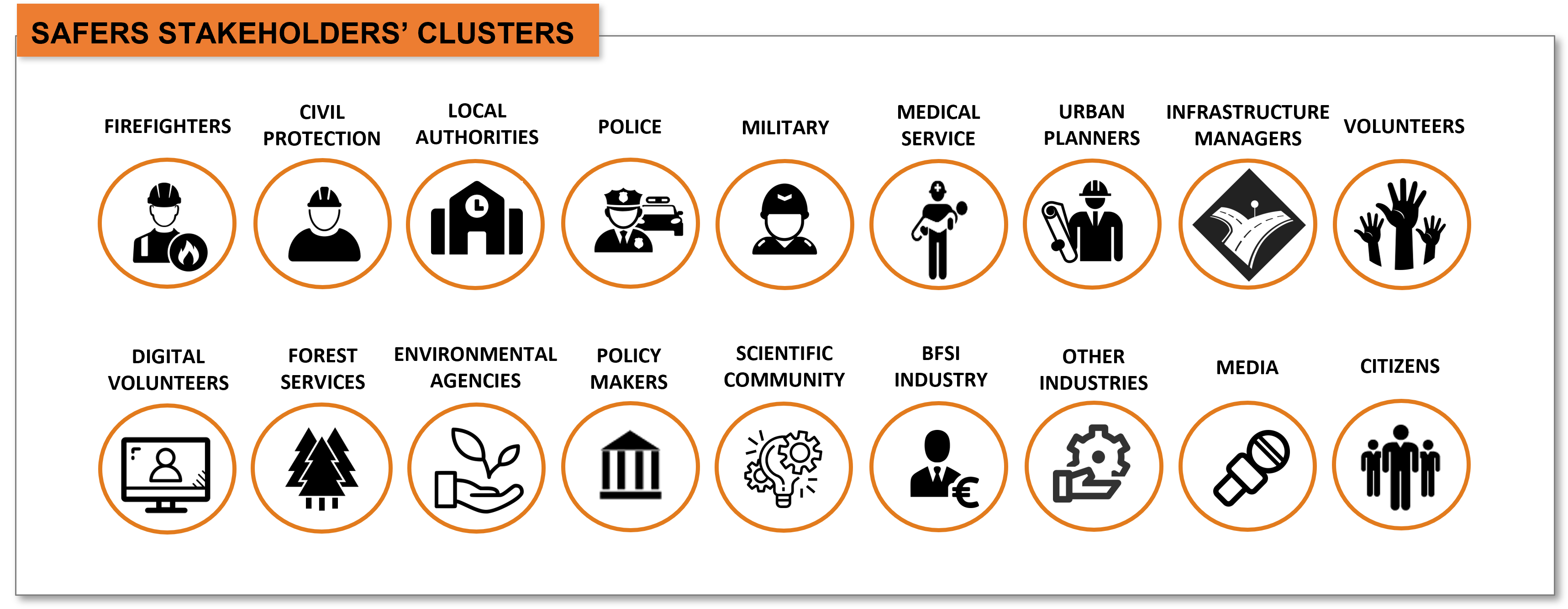
The engagement of stakeholders, who represent any group or institution with an interest in the project and who can be affected by it directly or indirectly, is a key factor for the success of the SAFERS project. SAFERS stakeholders have been identified and grouped in the following 18 clusters:
This first responders cluster group are at the forefront of the fight against forest fires disasters. Their main function is to stop fires and to rescue people to safe zones. Also, in many countries across the globe firefighters lead the fire prevention activities that are planned in high-risk areas. Firefighters are key players for the success of SAFERS and we seek to sharing experiences, knowledge and best practices as the in-field first responders are one of the main end-users of the project outcomes.
Like firefighters, civil protection group are considered as first responders at the forefront of protecting people and property in case of forest fires emergency. Civil protection staff are key players for the success of SAFERS and we seek to sharing experiences, knowledge and best practices as the in-field first responders are one of the main end-users of the project outcomes.
Local authorities such as the prefectures and municipalities support the forest fires in the preparedness and evacuation of citizens before and during the fire incidents. They also play an important role in raising the awareness of the local citizens on how to act when there is a forest fire incident, and they provide recommendations.
This cluster groups include the type of law enforcement personnel who are involved in management of forest fires, usually directing traffic control, and managing evacuation operations.
In certain countries, part of the military forces is deployed especially during the evacuation of citizens during large forest fires events.
This first responders cluster group involve all the stakeholders at the forefront of providing medical assistance to disaster victims. Examples include the red cross and local medical staff.
This category include regional planners, city planners, or rural planner who deal with the development and design of land use and the built environment, including air, water, and the infrastructure passing into and out of urban areas, such as transportation, communications, and distribution networks. In fire-prone areas, urban planners assess the location of critical facilities for the management of the emergency (e.g., hospitals, broadcast stations, fire stations, command and control rooms), as well as people with special evacuation needs (e.g., schools, hospitals, elderly homes, prisons).
This group involves the responsible for the design, installation, maintenance, and retirement of infrastructure in cities and regions (including transportation).
Trained volunteers and citizen responders can highly improve the emergency management capacity of Europe as they can serve as a link on site between the emergency management professionals and the general public during the different phases of the emergency management cycle. This cluster represents all the volunteers who work in fighting against forest fires or who are involved at any emergency management phase.
These services are usually administrated by ministries and national or regional agencies who work on the protection and management of forests and the environment.
This category represent the official agencies which work on environmental issues (e.g. water, biodiversity), whether through regulation, monitoring, information or policies.
Policy-makers include public authorities involved in or having an impact on the emergency management policies at the local, regional and national level across Europe and internationally. The adoption of novel emergency management systems depends on the approval of these authorities and thus establishing a fluent communication with these authorities is key for the successful implementation of SAFERS derived solutions.
The scientific community includes research centers, universities and scientific institutions who are i) directly involved in disaster risk management and forest fire management, ii) providing knowledge, data or services that can be used for forest fire management (e.g. meteorology office). SAFERS aims to encourage international collaborations among experts of different research fields while fostering scientific dissemination and knowledge exchange within Europe and beyond and publish scientific articles to ensure the knowledge exchange and collaboration are achieved. The Earth Observation Community is a sub-category of this cluster.
This category represents industries and the private sector overall (mainly ICT, insurance, real estate, public utilities, and agriculture), who can leverage on the SAFERS outcomes for making their products and services more competitive. This stakeholder cluster will be the main target to foster technology transfer and exploitation.
Digital volunteers were added as a separate cluster from the regular volunteers to differentiate between the group who takes part in field and the ones who volunteer in off-site and contribute to emergency management using the Internet via a computer, tablet, smart phone or other Internet-connected device. They mainly represent the VOST groups who collect incident information (e.g. alert messages, photos or weather predictions) from various online sources (i.e. social media and national official sources), and then filter them in order to discard the fake and/or irrelevant information, and send the information to civil protection authorities to support their decision making processes.
These stakeholders benefit from the innovative solutions for disaster risk reduction and the related information that could be valuable for the BFSI industry (e.g. informing their customers on fire risk, evaluation of risk for new contracts). These stakeholders can leverage on the SAFERS outcomes for making their products and services more competitive.
Citizens represent the society as a whole. The SAFERS project considers the differences among citizen groups (e.g. locals/ residents vs. visitors/tourists, urban vs. rural populations, online vs. offline community etc.) and tailors the communication and engagement actions and outreach the widest possible audience. This ultimately aims at enhancing the resilience of the European society and thus, its citizens are deemed to be the main stakeholder cluster for the consortium.
Media act the channels to reach all the other stakeholders and includes journalists, TV respondents and networking clusters. Media are also a source of data for SAFERS.
Join SAFERS community and be part of our activities. You may subscribe to our newsletter to add you to our stakeholders’ list so you receive our latest news and updates. You may also contact us at This email address is being protected from spambots. You need JavaScript enabled to view it.
Cookie Policy
This website uses cookies that are necessary to its functioning and required to achieve the purposes illustrated in the privacy policy. By accepting this OR scrolling this page OR continuing to browse, you agree to our privacy policy.