In this blog article, we present SAFERS Web-based dashboard for operational management and Decision Support. The Dashboard is one of the user-facing components of SAFERS. By providing a single interface for interacting with forest fire related data and information, the dashboard aims to improve the response efficiency of end-users when facing fire emergencies. There is a wide range of data flowing through the SAFERS architecture. Even though much of it is routed through a common Message Queue system, SAFERS still requires a user interface to make sense of the data and how it relates to potential and ongoing fire events.
This blog article covers the key details of the architecture, the implementation and the deployment of the Chatbot application that is integrated with SAFERS Web Dashboard. The Chatbot main goal is to increase the level of situational awareness and support the in-field operations of professional users as well as citizens in all the emergency phases, before, during and after it. In fact, it is able to deliver as well as to retrieve multimedia geolocated contents from registered users’ smartphones. Everyone has the possibility to access the Chatbot functionalities after having completed the registration procedure. To create a valid account, citizens must provide username and password. No other profile information is collected by the application.
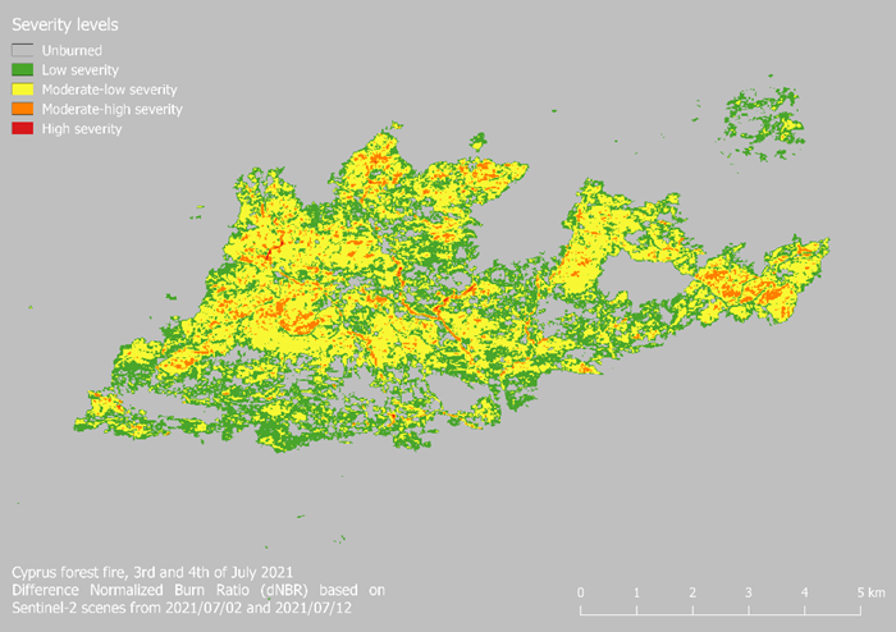
Strategic planning during and after hazardous events is strongly tied to the amount of information available to domain experts and decision makers. In the framework of SAFERS, the task - EO-based fire delineation and burned area for impact assessment (T3.6) is dedicated to the approaches and the devised solutions for rapid mapping and severity assessment utilizing satellite images as sources of data.
The conducted actions deal with the rapid damage assessment tools designed for the SAFERS project, namely a set of models and components to automate satellite mapping procedures and forecast evaluations that would require extensive manual labor in the first case, or extremely expensive simulations in the latter case. Given the results obtained within SAFERS, machine and deep learning solutions remain promising approaches for both scenarios.